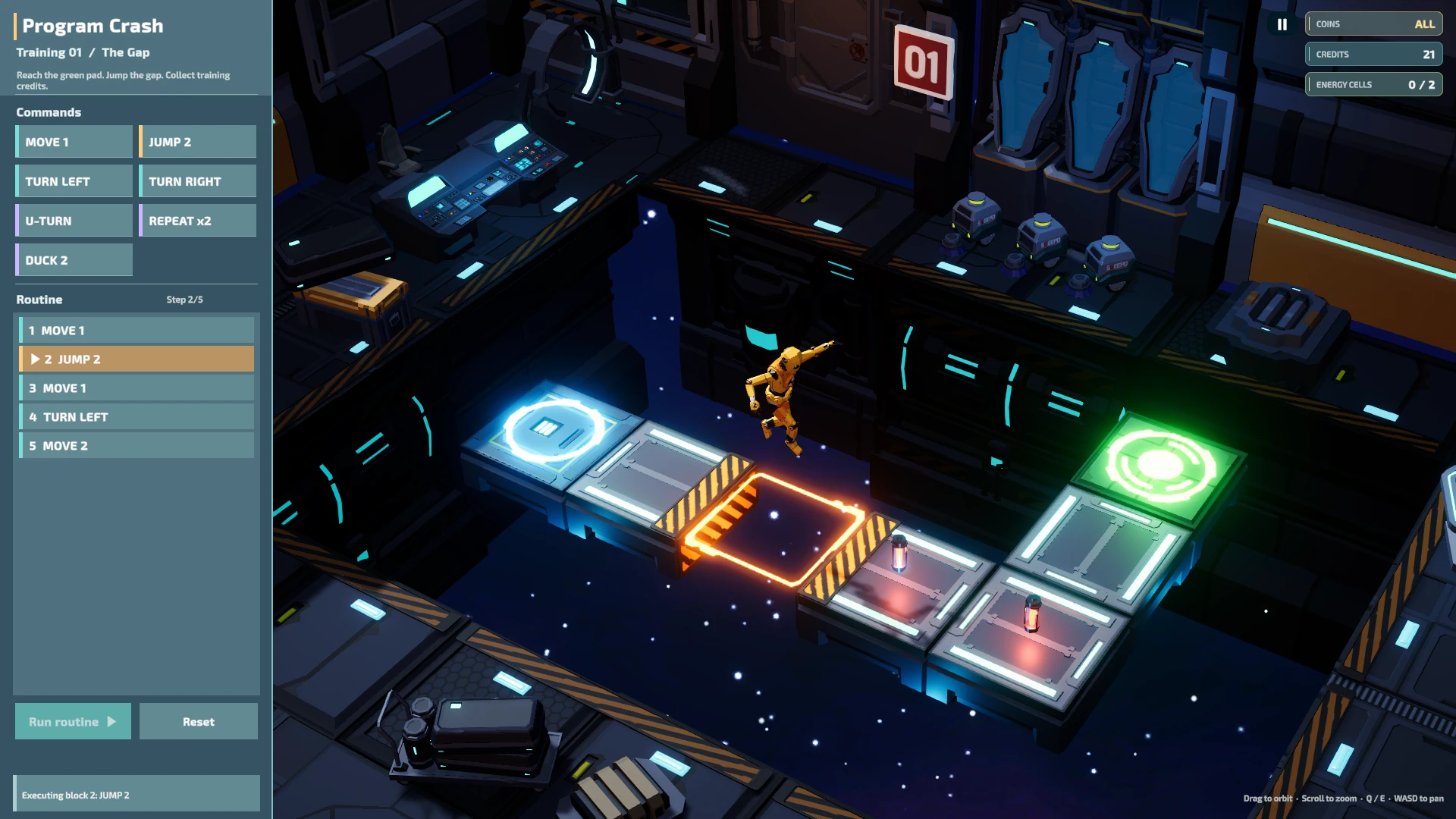
There’s a particular kind of satisfaction in watching a plan work. A robot takes a step, clears a gap, makes a turn, and lands exactly where you intended. A moment ago, that journey was just a few blocks in a list. Now it’s happening in front of you.
That’s the feeling we’re building One Command Ahead around.
You make the plan. The robot runs it.
One Command Ahead is a sci-fi puzzle game where you arrange commands into a routine, press Run, and watch your robot follow your instructions. Every move, turn, and jump belongs in that plan. If a gap is coming up, the robot won’t improvise a heroic leap. You have to put the jump in.
Sometimes the result is exactly what you pictured. Sometimes you discover that your robot’s left and your left are two very different things. Either way, you get something useful: a clear look at what your instructions actually did.
Then you change a block and try again.
Small beginnings, bigger possibilities
The journey starts at Orbital Academy Seven. The first courses give you room to learn the basics: a few spaces, a turn, a gap, and a goal. You don’t need to know a programming language before you arrive. The idea is to make each new command understandable through what it lets your robot do.
As the game grows, those simple instructions start working together in more interesting ways. Repeats turn patterns into compact routines. Ducking and sliding give you new ways past obstacles. Credits earned on successful runs open up more options in the depot.
Beyond the Academy, the Terrapin takes that thinking into a ship’s corridors. A limited battery adds another question to the plan: can you get there with the energy you have, or should you go looking for more?
A little personality goes a long way
A puzzle is more fun when the world has a pulse. Our robots have their own personalities and voices, even though they follow the same rules. Crash approaches the job with enthusiasm. Vega prefers precision. They’re companions for all those experiments, including the ones that end a little short of the landing pad.
We want a failed run to make you think, “I know what to change,” and maybe make you smile while you’re at it. Good feedback matters as much as a good challenge.
There’s something in those old terminals
Among the new machinery, something older is still listening. A green glow. A waiting prompt. A name you might recognize: Logo. Turtle Graphics.
We’ll leave the rest for the game. If those words spark a memory, or if you’ve never heard them before, our Logo history page explores the real story behind them without giving away the adventure.
What this blog is for
This is the first entry in our development log. We’ll use it to share how the game takes shape: what makes a course readable, how a command earns its place, and what changes when we watch a plan play out instead of just imagining it.
The screenshots here come from a development build. The game is still evolving, and we’re not announcing a release date in this post. Right now, the focus is on making that central loop feel good: inspect, arrange, run, understand, and try again.
Welcome to One Command Ahead. Let’s see where the next instruction takes us.